RoleBreakers
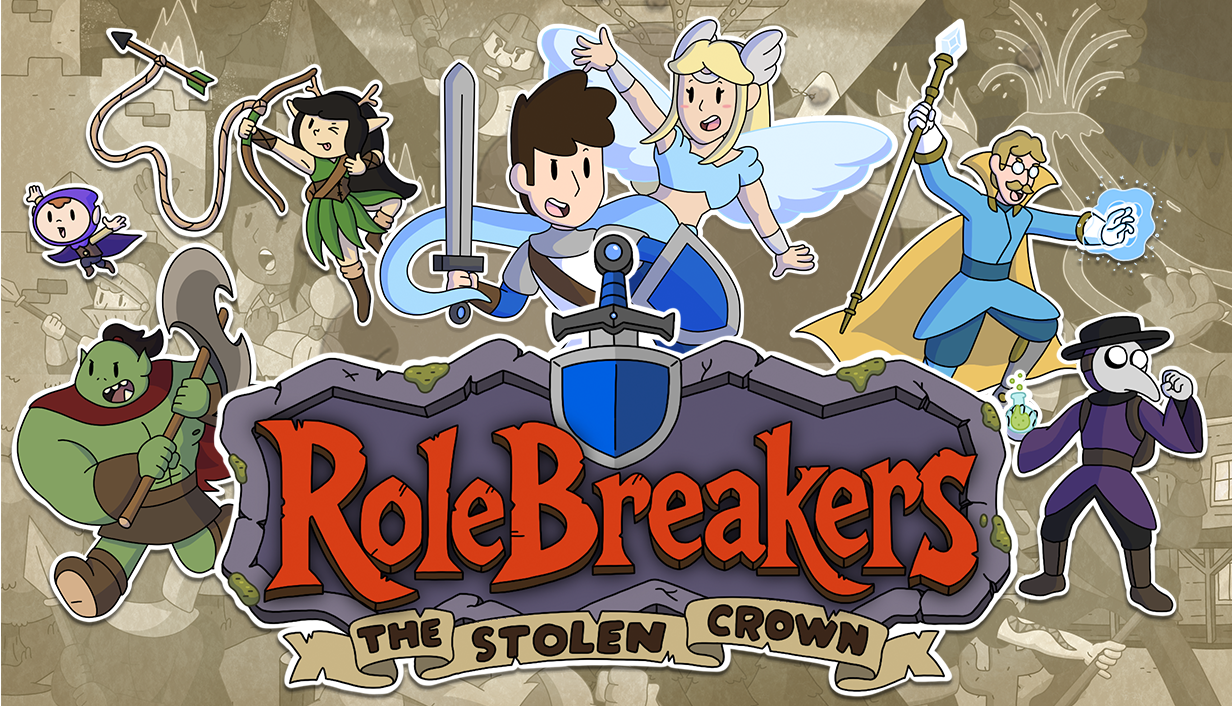
A hand drawn action-adventure about unlikely heroes, unlikely friendships, and breaking free from the roles the world assigns you.
3+ years
8-10 person team
Art Direction · Game Design · Animation · Narrative · Production
The Game
RoleBreakers is a hand drawn action-adventure game that combines classic Zelda inspired exploration and puzzle solving with a stronger emphasis on character driven storytelling.
I grew up loving adventures that let players explore fantasy worlds, overcome challenges, and embark on quests to save the day. But I also wanted to give the characters themselves more room to breathe. Rather than focusing solely on the journey, I wanted to explore the relationships, personalities, and personal struggles of the people taking it.
My goal was to build on familiar action-adventure mechanics while creating a world and cast that players would genuinely want to spend time with.
Designing the Gameplay
Familiar Mechanics · Interesting Combinations
I believe good game design doesn't always require inventing something entirely new. Sometimes the most interesting experiences come from taking familiar mechanics and combining them in unexpected ways.
RoleBreakers is built around three core pillars: combat, exploration, and puzzle solving. The companion system connects all three, giving players different ways to approach encounters and interact with the world.
Wes, our knight protagonist, provides a familiar foundation with his sword and shield. His companions introduce more specialized abilities, from Pandora's ranged attacks and grappling hook to Lance's strength based interactions with the environment.
I wanted each character to feel distinct without making any of them feel disconnected from the overall experience.
Designing Enemies Around Player Choice
One of my main goals for combat was to make the player's choice of companion meaningfully affect how an encounter unfolds.
When designing enemies, I consider how each character's moveset performs against them. Some abilities are especially effective, others are less efficient, and certain enemies require players to combine their tools to create an opening.
For example, an enemy hiding behind a shield can slow down Wes' direct attacks. Pandora's grappling ability, however, can break the enemy's defensive stance and give Wes an opportunity to strike.
This changes the pacing of the encounter. Instead of simply attacking until an enemy goes down, players can learn its behavior, choose the right tool, and take control of the fight.
I carry this philosophy into boss design as well. Boss arenas, environmental hazards, traversal mechanics, and previously learned abilities can all become part of the encounter. The goal is to make the environment an active part of combat rather than a backdrop.
Making Eva Part of the Core Mechanics
Eva began as a companion intended primarily to guide the player through the adventure. As development progressed, I saw an opportunity to make her much more integral to the gameplay.
Her possession ability allows her to inhabit certain constructs and mirror Wes' movements, opening up new possibilities for traversal, puzzles, and combat.
This created a design challenge: how could Eva become an essential mechanic without overshadowing the other companions?
My approach was to treat Wes and Eva as a cohesive gameplay unit while allowing them to remain distinct characters narratively. Her possession ability also creates opportunities to combine her mechanics with the other companions' abilities.
The result is a system with room for experimentation, where individual abilities become more interesting through the ways they interact.
Building a Cohesive Visual Identity
Character-Driven Art Direction
From the beginning, I wanted RoleBreakers to have a distinctive visual identity. I explored pixel art early in development, but ultimately felt that a hand drawn cartoon style better communicated the expressive personalities at the heart of the game.
My background in cartooning and animation, along with influences like Adventure Time, Gravity Falls, Regular Show, and Over the Garden Wall, helped shape the direction.
I wanted the characters to be expressive and immediately recognizable, with a style that felt cohesive across the world while remaining approachable for a team of artists to work in.
I primarily handle character art and animation, collaborating with our environment artist to maintain a consistent visual language across the game. Over time, the style has become cohesive enough that we can sometimes recognize an asset's creator only by checking our records.
Designing Characters Through Mechanics
I approach character design as an extension of gameplay design. A character's silhouette, proportions, colors, and clothing should help communicate who they are and how they play.
Wes' lean silhouette supports his role as a quick, agile knight, while his armored shoulders reinforce his defensive abilities. Lance's larger, more muscular build communicates strength and contrasts with Wes' speed focused design. Pandora's softer features and natural color palette support her identity as a ranged fighter connected to the forest.
I also use color to reinforce personality and create contrast between the cast. Wes' blue and silver evoke traditional heroic imagery, while Lance's red accents emphasize his more forceful personality.
These decisions help players read the characters visually while giving each one a recognizable identity within the larger ensemble.
Iteration: Knowing What to Change
Simplifying the Story to Strengthen the Experience
One of the biggest lessons from RoleBreakers has been recognizing when an ambitious idea is getting in the way of the experience I actually want to create.
The game's original story revolved around magical wish granting flowers, six kingdoms, an ancient betrayal, and a much more complicated web of lore. While I enjoyed the ideas individually, the overarching plot began to compete with the characters and their relationships for attention.
I wanted players to care about the people they traveled with, but the story required too much explanation to establish its central mystery and motivations.
I worked with our writer to rethink the narrative, replacing the elaborate wish flower mythology with a more straightforward conflict involving an ancient beast, six magical crowns, and a group of heroes trying to prevent its return.
This preserved the fantasy adventure structure while making the premise easier to communicate and leaving more room for the characters to drive the experience.
For me, this was a reminder that worldbuilding is most effective when it supports the story being told, rather than demanding attention for its own sake.
Scoping for a Stronger Game
I also initially envisioned a more open structure, allowing players to choose which companions they encountered first.
While appealing in theory, this introduced additional complexity into progression, narrative flow, and implementation. For a growing team, that complexity came with a real production cost.
I decided to move toward a more structured, chapter-based adventure. This gave each region a stronger identity, allowed the story to unfold more deliberately, and made it easier to develop distinct environments and experiences.
Rather than pursuing every possible feature, I focused on the systems and content that best supported the game's central vision.
Building the Team
RoleBreakers began with a small proof of concept I created to explore the fundamentals of a Zelda inspired action-adventure. I built an early version with basic movement, combat, enemies, dungeons, and inventory interactions to establish a playable foundation.
I used that prototype to bring in friends and former classmates who shared an interest in developing the game.
From there, the team gradually expanded to approximately 10 people across programming, art, design, audio, music, writing, production, and community facing work.
As creator and creative lead, I remain hands-on across much of the development process. I create the character art and most character animations, lead much of the game design, contribute to the worldbuilding and narrative, and help guide the artistic direction of the project.
I also coordinate with other disciplines to ensure their work supports the overall vision. That means collaborating with artists on visual consistency, discussing implementation with programmers, reviewing audio, and working with our writer to turn narrative concepts into dialogue and scenes.
Building the team has taught me that creative leadership isn't just about having a vision. It's about communicating that vision clearly enough that other people can contribute to it, improve it, and make it their own.
Taking the Game to Players
Showing RoleBreakers at showcases has become an important part of development.
Our early builds were rough, and I was initially nervous about presenting an unfinished game. However, those experiences taught me the value of putting an idea in front of players before every detail is polished.
Watching people engage with the characters, understand the gameplay, and offer feedback helped us identify what was already working and where the experience needed improvement.
Over time, we also refined our convention booth to make it more welcoming and interactive, giving visitors space to explore the game and talk with us afterward.
Showcases such as PlayNYC have become opportunities not only to share our work, but to learn from the people experiencing it.
Continuing Development
RoleBreakers continues to evolve as we refine the core experience and work toward a more polished playable demo.
Recent work has included refining player and companion movement, adjusting enemy placement and encounters, expanding playable content, and improving the feel of existing mechanics.
At this stage, the focus is on making the fundamentals feel cohesive and satisfying. Small differences in movement, timing, and responsiveness can have a significant effect on how familiar and enjoyable an action-adventure feels.
After years of building the game, I continue to approach development with the same principle that guided the original concept: make deliberate choices, refine what works, and keep the experience focused on the characters and mechanics that make it special.